What You See From the Eiffel Tower Summit — A 276 m Inventory
What's visible from the Eiffel Tower summit at 276 metres — landmark inventory by direction, visibility range, telescopes, haze, and what the photo from the top actually captures.
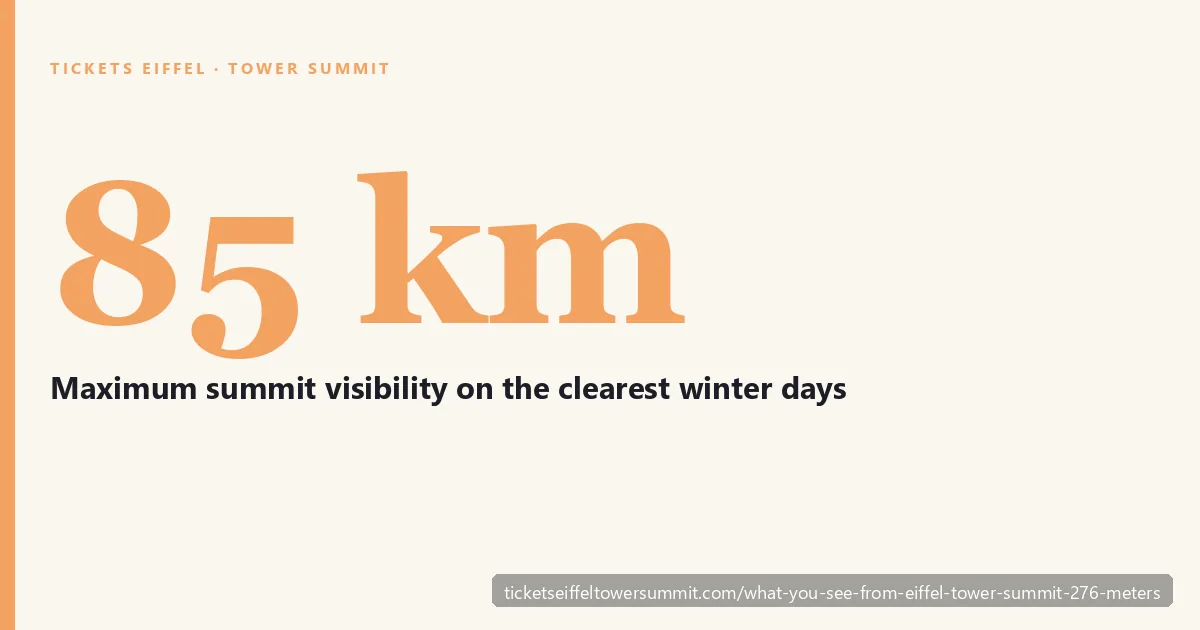
The summit deck of the Eiffel Tower is 276 metres above the Champ-de-Mars. On a clear day visibility reaches 70 to 80 kilometres, far enough to see well past the Île-de-France region into the surrounding countryside. On exceptional crystal-clear days — usually after a winter cold front clears the haze — visibility has been measured at 85 km, almost to the eastern edge of the Forêt de Lyons in Normandy (82 km north-west of the tower). This guide walks through what is actually visible from each side of the summit deck so you know what you are looking for before you book the summit ticket — and what the haze, the season, and the time of day take away.
The summit deck — a quick orientation
The summit is a two-level open-air observation deck at the very top of the iron structure. The lower level has the wraparound viewing terrace with safety mesh; the upper level — reached by a short interior staircase — holds Gustave Eiffel’s restored 19th-century office (preserved as a small museum exhibit with wax figures of Eiffel and Thomas Edison) and the historic champagne bar.
The deck is oriented to the four compass directions. The Seine bends east-to-west through your view, the Champ-de-Mars stretches south behind your shoulders, and the Trocadéro fountains and Palais de Chaillot face you across the river to the north. Coin-operated telescopes (around €1 per use) are mounted at each cardinal point and labelled in French, English and Spanish.
Landmark inventory by direction
What you see depends on which side of the summit deck you walk to. Here is a quick reference:
| Direction | Distance | Landmark | Notes |
|---|---|---|---|
| North | 1.5 km | Trocadéro & Palais de Chaillot | The fountains and the curved palace facing the tower — postcard symmetry |
| North-east | 4.7 km | Sacré-Cœur Basilica (Montmartre) | White dome on the highest natural hill in Paris — unmistakable |
| East | 2 km | Place de la Concorde + Tuileries | The obelisk and the formal gardens leading to the Louvre |
| East | 2.5 km | Louvre + Tuileries | The U-shape of the palace and the long glass pyramid of the courtyard |
| East | 4.1 km | Notre-Dame Cathedral | Reopened December 2024; the two towers reopened to visitors on 20 September 2025 (around €16, online reservation required) — twin towers visible on the Île de la Cité |
| East | 4.5 km | Centre Pompidou | The colourful industrial building (closed for renovation September 2025 through approximately 2030) |
| South-east | 5 km | Panthéon + Latin Quarter | The grey dome dominates the Left Bank skyline |
| South | <1 km | Champ-de-Mars + École Militaire | The long park directly below; the École’s classical facade at the far end |
| South | 6 km | Tour Montparnasse | The black tower of the 56th-floor deck (closed for renovation through approximately 2030) |
| South-west | 14 km | Palace of Versailles | Visible on clear days as a distant cluster of buildings on the SW horizon; the palace itself hard to pick out unaided |
| West | 2.3 km | Bois de Boulogne (nearest edge) | The large green expanse on the west edge of the city |
| West | 5.7 km | La Défense (Grande Arche) | The modern skyscraper district with the Grande Arche — visible as a cluster of glass towers |
| North | 8.6 km | Aquatics Centre Saint-Denis | 2024 Olympics legacy venue; visible to the north on the Saint-Denis skyline |
| North | 8.8 km | Stade de France | National stadium on the same Saint-Denis approach |
| East | 8.2 km | Bois de Vincennes (nearest edge) | The other big city park; the far edge of inner Paris |
| East | 35 km | Disneyland Paris (Marne-la-Vallée) | Resort skyline visible on exceptionally clear days; far horizon haze hides it most days |
How far can you actually see — the visibility math
The summit deck is at 276 m. Earth’s curvature means the geometric horizon from 276 m is roughly 59 km without atmospheric refraction, around 65–70 km with normal refraction, and longer still on cold dense days when refraction is strongest.
But geometric horizon is not the same as practical visibility:
- Crystal-clear winter morning after a cold front — 70–80 km, sometimes the magic 85 km
- Average clear day — 30–40 km practical, you see the suburbs clearly but exurban detail blurs
- Hazy summer afternoon — 10–20 km, you see central Paris well but the horizon is white
- Rainy or low-pressure day — 5 km or less, you may not see Notre-Dame at all
- Smog episode (rare in modern Paris but happens) — sub-5 km
The best visibility is in November–March on the first clear day after a storm front clears. The worst is July–August afternoons when heat builds up haze over the city. Morning slots in summer (the first lift around 9:30) give substantially clearer views than 14:00 slots the same day.
What gets foreshortened, what gets enhanced
From 276 m, three perceptual things happen that ground-level photos do not prepare you for:
Ground-level detail disappears. People are dots; cars are coloured rectangles; even Seine tour boats look like matchsticks. The Place de la Concorde reads as a beige rectangle, not as the elaborate plaza you saw from street level. If you want to identify your hotel or your favourite café from the summit, you almost certainly cannot.
The grid of Paris becomes legible. Haussmann’s 19th-century redesign of Paris into wide avenues radiating from squares is invisible at street level and obvious from the summit. The Champs-Élysées is suddenly the spine of the Right Bank; the avenues radiating from Étoile look like a star; the layered crescents of the Boulevard des Maréchaux trace the old city walls.
Tall things look smaller, low things look flat. Notre-Dame’s twin towers are 69 m — from the summit you are 207 m above their tops, so they look modest. The Louvre, despite being a massive complex, reads as a long thin U-shape because you are seeing it almost from above. Conversely the Sacré-Cœur’s white dome looks dramatic because Montmartre’s natural hill (130 m elevation) gives it height the surrounding city lacks.
What the 2024 Olympics left behind — and what is gone
Two years after the Paris 2024 Olympics, two of the most-photographed temporary venues that visitors saw on the skyline from the summit have very different fates. The Grand Palais Éphémère — the white temporary pavilion that occupied the southern end of the Champ-de-Mars and that summit visitors could see directly below them throughout 2024 — was dismantled in April 2025 once the Grand Palais on the Champs-Élysées side completed its restoration. The lawn is now back to its pre-Olympics state and is visible from the summit as the unbroken green axis from the École Militaire to the tower.
The Olympic Aquatics Centre at Saint-Denis (8.6 km north) is permanent and was always intended to be — its wave-roof silhouette is visible on the north horizon next to the Stade de France. The Olympic Village in Saint-Ouen and the surrounding regenerated districts are part of the suburban gradient you see to the north on clear days.
The brief floating-pool sections of the Seine staged for the 2024 triathlon are gone. The river view from the summit is back to its pre-Olympics state — bateaux-mouches, the central islands, and the bridges.
Weather and the view — what each condition does to visibility
A clear-day vs hazy-day summit visit gives genuinely different experiences. The weather details that matter most:
- High pressure with clear sky is the best summit weather. Atmospheric haze drops to its annual minimum after cold fronts clear the Paris basin air, and on a December morning following a clean Atlantic clearance you can see the far west horizon to La Défense and well beyond. Counter-intuitively, the clearest summit days are often the coldest.
- Summer afternoon haze is the most-encountered visibility-killer. Heat builds a particulate haze over the city that can drop practical visibility from 70 km to 15–20 km in a single afternoon. Distant landmarks (Versailles, the eastern suburbs) disappear into white-out; central Paris views (Notre-Dame at 4 km, Sacré-Cœur at 3 km) remain clear.
- Light rain or drizzle typically does not close the summit (only sustained wind and storms do that), but the view becomes textured rather than transparent. The Champ-de-Mars below looks darker, the Seine reflects more, and the photo aesthetic shifts from “vista” to “atmospheric.” Many photographers prefer this look to a flat blue-sky day.
- Low cloud and fog is the rarest condition; central Paris fog typically clears by mid-morning, but occasionally a low ceiling at 200–250 m means the summit deck is literally inside the cloud. The photo opportunity is unique (the iron lattice disappearing into mist) but the view is essentially zero.
- High thin cirrus with blue underneath is the under-rated optimal photo condition. The clouds soften direct sun, give the sky texture, and let landmark detail read at distance without harsh contrast. Some of the best long-distance summit photos are taken under cirrus, not under cloudless blue.
The morning of your visit, the single most useful weather signal for predicting summit visibility is barometric pressure trend. Rising pressure after a low = clean dry air = best visibility. Falling pressure ahead of a front = haze and humidity = poor visibility (and possibly a closure later in the day).
The telescopes — worth using or skip?
The summit has coin-operated telescopes at each cardinal point. They are useful for one specific thing: picking out distant landmarks you cannot identify with the naked eye. The Versailles cluster to the south-west, the La Défense skyscrapers, the Bois de Vincennes on the far edge of the city — all benefit from 4–8× magnification.
They are less useful for landmark-spotting in central Paris, because at central-Paris distances (2–5 km) your naked eye sees the landmarks fine and the telescope’s narrow field of view actually makes it harder to orient. Save the coins for the far view.
Bring binoculars if you are a serious view-watcher; the summit is one of the rare urban viewpoints where 8× binoculars genuinely add detail rather than just shake. Phone cameras have a hard time with the 276 m vista because the optical zoom on a phone is not equivalent to genuine magnification — wide-angle landscape shots from the summit usually look more impressive than a phone-zoomed crop of a distant landmark.
The summit-only details you miss from the 2nd floor
The 2nd-floor terrace at 115 m gives most of the panorama. What the summit adds, beyond raw height:
- The horizon line — at 115 m the horizon is around 38 km; at 276 m it is 65 km+. The far suburbs and the countryside beyond are summit-only.
- The sense of being above central Paris — at 115 m you are still below the Sacré-Cœur’s elevation (Montmartre + the basilica’s dome reach roughly 213 m above the Seine). At 276 m you are above every other natural and built feature of the city.
- Gustave Eiffel’s restored office — preserved as part of the original 1889 build; only accessible from the summit upper level.
- The champagne bar — a small kiosk on the upper level; sells flutes of champagne for the once-in-a-lifetime photo.
- The vertical view back down through the iron lattice — the summit lift comes up through the structure and the descent shows you the bones of the tower in a way the 2nd-floor visit does not.
The 2nd floor still has the famous glass floor on Level 1 (57 m above the Champ-de-Mars), the Madame Brasserie restaurant on the 1st floor, and the Le Jules Verne Michelin-starred restaurant on the 2nd floor — neither at the summit, despite frequent visitor confusion.
When to time your summit slot for the best view
| Slot | Visibility | Crowd | Photo quality |
|---|---|---|---|
| 09:30 first lift (summer) | Excellent — clearest air of the day | Lowest | Soft morning light, east-facing landmarks lit |
| 11:00–13:00 | Good | Building | Flat overhead light, weakest photo time |
| 14:00–16:00 | Reduced by haze in summer | Peak | Warm light starting; long queues at unbooked walk-ups |
| Sunset slot (varies by season — around 22:00 June 21 / 17:00 December 21) | Variable but most atmospheric | Moderate | Golden hour, Eiffel sparkle photogenic from below |
| Last lift (21:30 winter / 22:30 summer) | Dark, city-lights view | Lowest of evening | Night photography; sparkle visible from Trocadéro |
Sunset slot is the most-requested by photographers and the hardest to book; if your trip dates allow flexibility, book it as early as possible. Paris sunset times shift dramatically — around 17:00 at the winter solstice, around 22:00 at the summer solstice — so check the actual time for your travel dates when picking a slot.
Ready to Book?
The featured Eiffel Tower 2nd Floor or Summit Access ticket is from $76 per person — host walk-in past the main queue, elevator to the 2nd-floor terrace, private summit lift to 276 m, unlimited time inside. 4.7/5 from 6,960 verified visitors. Free cancellation up to 24 hours before.
See Paris from 276 m — Summit Ticket, Skip-the-Queue Host
Join 6,960 visitors who rated this experience 4.7/5. Pre-booked ticket, skip-the-main-queue host at the Champ de Mars meeting point, elevator up to the 2nd-floor terrace, and the private summit lift to 276 m — all from $76 per person with free cancellation up to 24h.
Check Summit Availability