Eiffel Tower Summit Closures: Wind, Weather & What You Get Back
When the Eiffel Tower summit closes — SETE wind threshold, storms, refund rules, how to check status morning-of, and what your ticket still covers when the top is shut.
The 276-metre summit is the reason most visitors book the upgrade over the 2nd-floor-only ticket. It is also the one floor of the tower that closes for reasons beyond ticket availability — wind, storms, and the operator’s own safety calls all shut the top while the lower floors keep running. If you have already pre-booked the featured summit ticket, or are deciding whether the summit option is worth the surcharge, this guide explains exactly when the top closes, what happens to your booking, and how to read the morning-of forecast like a SETE duty manager.
Who decides when the summit closes — and why it matters
The Eiffel Tower is operated by SETE (Société d’Exploitation de la Tour Eiffel), a public-private company majority-owned (around 99%) by the City of Paris since 2005. SETE — not the City, not the meteorological service, not the tour reseller you booked through — makes the call to close the summit, and the decision is made on the day, often morning-of, sometimes hour-by-hour as wind picks up.
This matters because nobody outside SETE can tell you in advance whether the summit will be open at 14:00 tomorrow. Forecasts give probability; the duty manager gives the answer. The 4.7/5 rating from 6,960 visitors on our featured ticket reflects an operator who hands the physical ticket to you at the meeting point and walks you in, so they get SETE’s decision in real time — which is exactly what you want when conditions are marginal.
The wind threshold — sustained 80 km/h is the trigger
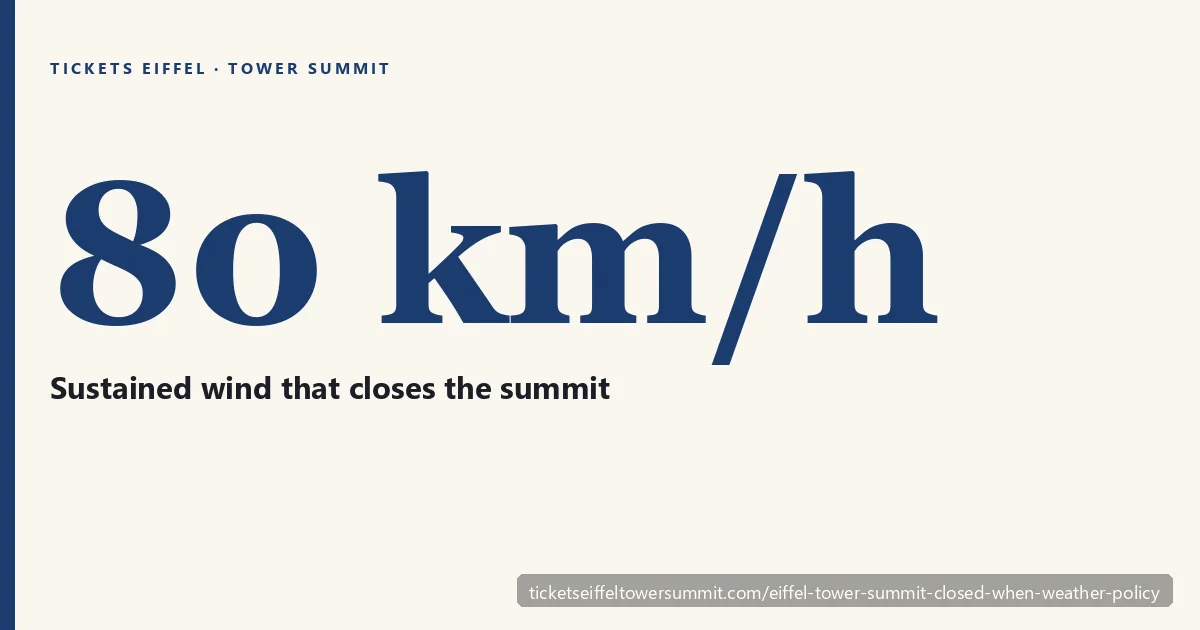
The summit closes automatically when sustained wind at the top reaches the safety threshold, which SETE sets at around 80 km/h (about 50 mph). The lift cables and the open-air summit deck become unsafe to operate above that wind speed — the lift sways, doors don’t seat properly, and visitors at the top can be blown off balance. Gusts above the threshold without sustained wind sometimes count, sometimes don’t; SETE’s duty engineer makes the judgement.
The full-tower evacuation threshold is much higher — gusts around 130 km/h trigger an evacuation of all floors. In practice that happens only a handful of times a year, usually during named Atlantic storms. The summit-only closure at 80 km/h is the one you are far more likely to hit.
The lower floors — 1st (57 m) and 2nd (115 m) — stay open at much higher wind speeds. They are partially enclosed, the lifts to those floors are inside the tower’s iron frame, and the glass floor on Level 1 is sheltered. So a “summit closed” day is almost never a “tower closed” day. You still get your 2nd-floor visit, you just don’t ascend the final stage.
When closures happen most often
Wind closures cluster around storm fronts, but they are not seasonal in any predictable way:
| Pattern | When | How often summit closes |
|---|---|---|
| Atlantic depressions | Oct–Mar (most common) | Several days per month during stormy weeks |
| Spring squalls | Mar–May | Occasional, often morning-only |
| Summer thunderstorms | Jun–Aug | Brief, often re-opens within a couple of hours |
| Autumn equinox gales | Sept–Oct | Multi-day stretches possible |
| Calm high-pressure days | Anytime | Summit open from first lift to last |
Practically: if your trip is in the cooler half of the year, build a flex day. If you are in Paris for 48 hours in February and the summit is non-negotiable, book the first available slot of your trip so a closure on day one still leaves you a second attempt on day two.
Other reasons the summit closes (not just wind)
The wind threshold is the most common trigger, but several others matter:
- Lightning and severe storms — the tower is a giant lightning rod and is hit dozens of times a year. Storm cells overhead = summit closes, often the 2nd floor too, until the cell clears.
- Heavy snow or ice — Paris snow is rare but the lift mechanisms and the open summit deck become unsafe. Closures here can last a full day.
- Security operations — controlled by SETE in coordination with Paris police; closures here are unannounced and usually short.
- Bastille Day (14 July) — the tower typically closes early for the evening light show and fireworks staging; pre-booked tickets for that slot are reissued or refunded.
- Scheduled maintenance — the summit lift undergoes annual maintenance; SETE publishes maintenance windows in advance and tickets are not sold for those dates.
- Labour action (rare but disruptive) — the SETE workforce went on strike from 19 to 24 February 2024 (six days) over the tower’s funding model, closing the entire monument on the strike days. Strikes have been less common since but remain on the list of possible closure causes; SETE typically gives 24–48 hours notice when industrial action is confirmed, and ticket holders are refunded or rescheduled.
What happens to your ticket when the summit closes
Three scenarios, three outcomes:
1. Summit is closed before you arrive at the meeting point
You will know at the Champ-de-Mars meeting point — your host gets SETE’s call in real time. The host downgrades the booking to 2nd-floor-only access on the spot and you are refunded the price difference between the summit and 2nd-floor tickets (around $12 on the featured ticket). The 1st and 2nd floors stay open and your visit proceeds normally; the 2nd-floor terrace at 115 m is still the second-highest paid viewpoint in Paris and includes the glass floor on Level 1.
2. Summit closes after you have already gone up
If the wind picks up between your arrival on the 2nd floor and your summit slot, SETE may halt new lift trips and only complete the down-runs. Anyone already at the summit is brought down; anyone holding a summit ticket but still on the 2nd floor gets the price difference refunded on the same automatic terms.
3. Summit closes the whole day before you arrive
Free cancellation up to 24 hours before your slot lets you reschedule the entire booking if the forecast is poor. After the 24-hour window closes, the rebook is at the operator’s discretion — most will move you to the next available slot rather than refund, but this is not guaranteed.
How to check status the morning of your visit
SETE’s official live status page is the only authoritative source. Check it 2–3 hours before your slot:
- toureiffel.paris — the SETE site publishes a “Today at the Eiffel Tower” notice that flags summit closure, partial closure, or full closure
- Paris weather forecast — look for sustained wind above 60 km/h in the city centre (Météo-France or any standard forecast); if forecast winds are 50 km/h or less at altitude, the summit will almost certainly be open
- Webcams — the tower has live webcams on the southern and Trocadéro approaches; a clear webcam doesn’t guarantee the summit is open (wind matters more than visibility), but a webcam showing the top of the tower disappearing into low cloud is a red flag
The thing nobody mentions: the lift queue from the 2nd floor to the summit is itself a separate bottleneck. Even on an open day the summit lift can have a 20–40 minute internal queue at peak hours. Pre-booking with the host service skips the main security queue at the base but not the internal summit-lift queue at the top — useful to know if your slot is the last lift of the evening.
Worst-weather-decisions checklist
Quick decision tool for the morning of your visit:
| Forecast says… | Summit likely | What to do |
|---|---|---|
| Wind 40 km/h, blue sky | Open | Go. Bring a layer; even calm days are cool at 276 m |
| Wind 60 km/h, scattered cloud | Probably open | Go. Visibility may be 20–30 km rather than 70+ |
| Wind 70–80 km/h or gusty | Marginal | Go anyway — you get refunded if it closes |
| Wind 90+ km/h sustained | Almost certainly closed | Rebook if within the 24h window |
| Gusts forecast above 130 km/h | Full tower likely closed | Rebook in advance — entire tower may evacuate |
| Active thunderstorm cell | Summit closed | Wait it out; cell usually clears in 1–2 h |
| Heavy snow or freezing rain | Closed all day | Use the 24h free cancellation to move |
| Forecast simply uncertain | Anything | Book a morning slot; conditions worsen later in the day on stormy systems |
How storm frequency varies through the year
If you are picking a travel month and want to maximise your odds of getting the summit, the underlying Paris climate matters as much as the SETE policy:
- June through September is the calmest stretch. Atlantic depressions track north of Paris in summer, and the city sees stable high pressure for days at a time. Summit-closure days in summer are dominated by isolated thunderstorms rather than sustained-wind events; a closure is more likely to last 60–90 minutes than a full day.
- October through November is the swing season. The first equinox gales arrive, named Atlantic storms become more common (Met Office and Météo-France start their named-storm season in early September), and a multi-day closure becomes possible for the first time since spring.
- December through February is the most closure-prone period. Atlantic depressions track directly across northern France; sustained wind events of 60–80 km/h at altitude are routine, and the summit can close for stretches of consecutive days when a storm system stalls. Visitors building winter trips around the Eiffel summit should book a flex day.
- March through May sees declining storminess but lingering spring squalls. Late afternoon thunderstorms become common from late April onward; morning slots are noticeably more reliable than afternoon slots in this window.
For visitors who absolutely cannot accept a summit downgrade, the booking play is: travel in late May, June, or September; book the first available slot of your trip; keep the next morning open as a backup. That bracket gives you the highest statistical probability of getting the summit on the first attempt without paying summer-peak prices.
What the 2nd floor still gives you
If the summit is shut and your booking has been downgraded, the 2nd floor is the consolation prize that most visitors didn’t realise was the main event. From 115 m you get:
- The full 360° panorama — Sacré-Cœur to the north, Notre-Dame to the east, the Seine bend through the centre, Trocadéro across the river
- The glass floor on Level 1, 57 m above the Champ-de-Mars
- The Madame Brasserie on the 1st floor (booking separate)
- The Le Jules Verne restaurant on the 2nd floor (booking separate; Michelin-starred)
- The history exhibits and the open-air terrace at 115 m
Visitors with summit tickets who got downgraded routinely report on review sites that they barely missed the top — the 2nd floor view, especially with the glass floor and the terrace, delivers most of the “I’m on the Eiffel Tower” experience. The 276 m summit adds the iconic photo and Gustave Eiffel’s restored office, but it does not add a meaningfully different panorama on a hazy day.
Ready to Book?
The featured ticket is the Eiffel Tower 2nd Floor or Summit Access — from $76 per person with an English-speaking host who walks the group past the main queue, gets SETE’s live status call, and handles any summit downgrade refund on the spot. Free cancellation up to 24 hours before. 4.7/5 from 6,960 verified visitors.
See Paris from 276 m — Summit Ticket, Skip-the-Queue Host
Join 6,960 visitors who rated this experience 4.7/5. Pre-booked ticket, skip-the-main-queue host at the Champ de Mars meeting point, elevator up to the 2nd-floor terrace, and the private summit lift to 276 m — all from $76 per person with free cancellation up to 24h.
Check Summit Availability